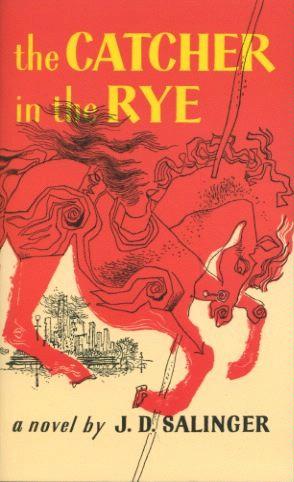
 The Catcher in the Rye
by J. D. Salinger
The Catcher in the Rye was a book club pick and, although I’ve read it probably ten times prior to this, I was happy to be reading it again. I love book club for driving me to read more actively – and also I end up scouring the internet for additional analyses, side-stories, any additional information to understand the author or the premise of the story. This time was no different. I know that JD Salinger was a notorious recluse, but after having read CITR once more and then listening to some NPR interviews conducted after his death a couple years ago, I feel a strong connection between Holden Caulfield and Salinger himself (most people won’t be surprised by that statement). One interviewer on NPR asked some literary folks what they imagine the adult Holden to be; I think neither of them could answer. (Sounded to me like they were stuck on Holden in that time and place, and they had a lot of questions about whether or not he truly escaped his depression that lands him in a psychiatric hospital at the end of the book.) In my opinion, I like to think that he did escape it. Or at least have a relatively normal life, in the sense that he goes on to get his education, find sustaining work of some sort, having fulfilling interpersonal relationships (e.g. wife), and probably even have a family. After listening to another NPR segment on Salinger, I realize that HE is the grown-up version of Holden. Salinger famously said that he wrote for himself and only for himself, not for the fame or fortune or gravitas of standing for something to anyone else. He lived in great seclusion, refused to speak to the media, and upon his death insisted that none of his manuscripts ever be published (much less, I think he wanted to them destroyed.) This sounds so much to me like EXACTLY Holden’s wish when he describes living in the woods in California somewhere as a mute. He describes even being married to a wonderful woman who lives with him in his cabin and has to communicate with him through hand-written notes on paper, because he’s so vehemently anti-phony and, apparently to Holden, speaking aloud represents an opportunity for corruption of the authentic. Sure sounds similar to how Salinger’s life turned out, in a way. Not that he was necessarily unhappy or refused to speak to anyone in his own house; just that he felt extremely sensitive to anything less than authentic and valued his privacy so much that he had no inclination to be involved in the outside world. Really interesting.
Aside from that, I really liked the book again. Mostly I think it’s about Holden and Holden’s family grieving over the loss of Allie, Holden’s younger brother, who died of leukemia a few years earlier and was a sweetheart of a kid. Sounds like Holden’s father is pretty much out of the picture, being entirely preoccupied with work, and Holden’s mother isn’t the same since her son’s death, to the point where Holden feels completely unsupported by his parents and as if he’s thrust into (perceived) adulthood. This—combined with his super sensitivity to what he calls phony-ness, or just less-than-genuine and sincere actions that we witnesses all around him—leads him to think fondly of nothing but the innocence and un-self-consciousness of children and a child’s life.
I don’t think he doesn’t make it out of his depression; I do think he grows up to be an extremely sensitive and observant adult, who learns very early on about the preciousness of life and genuine interpersonal human interactions. I wonder how much of Salinger is truly reflected in Caulfield. Likely we’ll never get the answer to that one.

No comments:
Post a Comment