Movie review:
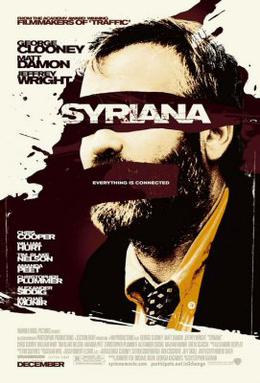
Syriana
written and directed by Stephen Gaghan
February 26, 2011
This movie was hard to keep up with. I've had to refer to Wikipedia to get the critical plot points connected to one another.
For one thing, this movie is another example of George Clooney choosing interesting, unglamorous, morally-conflicted roles in which his character ultimately struggles with right and wrong, good and evil, in a complicated world where nothing is simple or clear or not multi-layered. (Other films in this category for Clooney are Good Night and Good Luck, Michael Clayton, and Up in the Air, which is probably only an incomplete list.) In this case, he plays Bob Barnes, a veteran CIA agent, who jumps the fence when he finds himself playing for the wrong team.
After watching the film a second time (at least the first half, before I fell asleep too early on a Friday night) and taking notes, my conclusions are that Syriana is a solid movie. Its complicated, herky-jerky, jump-around style that connects five or six disparate story lines, however, gives the impression of something deeper than I think it actually is. The message of the storyline following the Pakistani father and son in the unidentified Gulf state, for example, is no deeper than that lack of work due to a bad economy leaves a young man vulnerable to persuasion via ultraconservative religious dogma to commit jihadi suicide -- directed, quaintly (if that's the right word), at the multinational corporation that took away his job. (As I right this, however, Syriana may be proven right, in a way, since the global economic recession of the last few years seems to be a match thrown on the fuel of widespread discontent under absolutist regimes throughout the Arab world, which is now erupting in protests, political coups, and civil war. So... my film critique here is not meant to the belittle the role that economic empowerment can play for certain groups, which is certainly an important one.)
Anyway, I still think the most intriguing aspect of the film is the involvement of George Clooney in (yet) another film in which he plays a character who is either himself morally ambiguous or else tied up in a broader scheme of moral ambiguity from which he must disengage himself, somehow.
I wonder if these types of films are acknowledged and consciously en vogue in Hollywood. Are screenwriters writing them, producers and directors executing them, and actors bringing life to them because they believe in the point? (By "point" here, I mean that all things are connected and that we must try to perceive as many of the consequences of our actions as possible, therefore. And, that the US and multinational corporations sometimes wreak devastation, unwittingly, on parties big and small. And that maybe we should try to understand better the ripple effects of those actions or else not make them.) Anyway, it's not a bad idea, but I also wonder to what extent these movies are made because there is a minor (or not so minor) demand for them. My questions are, who is watching them and what was there opinion regarding this topic before and after seeing the movie? Was anyone's political position altered? I wonder if like-minded folks are only being reaffirmed in their ideas (which will never encompass all the complexity, truly -- myself included!) by watching these movies, but not really learning anything new or being spurred on to try to generate change in "real life." Because, for sure, paying $13 for a movie ticket on Saturday night isn't doing much to alter any situations analogous to the one depicted in the movie.

No comments:
Post a Comment